1 Nephi 1-7
1 Nephi 1-7
Historical Background and Setting of the Book of Mormon
| 609 B.C. | King Josiah | Josiah lost his life at the Battle of Megiddo in 609 B.C., leading his armies to stop the advance of the Egyptians, under Pharaoh Nechoh, toward the Euphrates. Nechoh gained control of Judah’s political life. |
| 609 B.C. | Jehoahaz | Son of Josiah. Became king at his fathers death. Because of wickedness and Intrigue Nechoh took him away to Egypt and put his brother Eliakim on the throne. His name was changed to Jehoiachin. He reigned 11 years. |
| 598 B.C. | Jehoiakim | Jehoiakim was bound and carried away to Babylon by Nebuchadnezzar along with thousands of others. |
| Jehoiachin | Jehoiakim’s son allowed to rule as a vassal king of the Babylonians. He reigned only three months and then was summoned to Babylon along with "ten thousand captives, and all the craftsmen and smiths." 2 Kings 24:11-17 - Nebuchadnezzar, Assyrian siege of Jerusalem | |
| 598 B.C. | Zedekiah | Jehoiachin’s uncle, Mattaniah began to reign in his stead. His name was changed to Zedekiah. Book of Mormon history begins in the first year of Zedekiah's reign. According to Bible chronology, that was in 598 or 597 B.C. Jerusalem left in a vacuum with few men of valour, smiths or leaders. |
| The Prophets | Nephi wrote that "there came many prophets prophesying unto the people that they must repent, or the great city of Jerusalem must be destroyed" (1 Nephi 1:4). Lehi’s contemporaries included Jeremiah, Huldah, Zephaniah, Habukkuk, Ezekiel, and Urijah of Kirjath-jearim. | |
| Lehi's Home | According to 1 Nephi 1:4 and 1:7, Lehi and his family were living at Jerusalem. The preposition "at" in this case could mean on, in, within, close by, or near. In fact we learn that his house is some distance from Jerusalem proper. Any satellite towns or villages that surrounded larger population centers were regarded in ancient times as belonging to those larger centers. That Lehi and his family lived outside of Jerusalem proper is evidenced in the account of the sons' attempt to obtain the plates with their abandoned wealth: "We went down to the land of our inheritance, and we did gather together our gold, and our silver, and our precious things. And after we gathered these things together, we went up unto the house of Laban" (1 Nephi 3:22-23). |
Jerusalem from above - understand it's topography and history
Israel from the air - overview of countryside, and cities from the air
Interesting Points of Note:
Jerusalem had been sacked and the people taken away from it twice in the last 20 years of Lehi's life at Jerusalem. All of the mighty men of valour and smiths had been removed from Jerusalem during this time. This would have left a leadership and craftsmen vacuum in the area which would have had a great impact on the remaining populace.
Consider this - as the ministry of Lehi begins - his prophecy was that Jerusalem would be destroyed - it had already been attacked and 1000's of people taken. How would this impact the people who heard his testimony? Wouldn't they have thought - this has already happened... why would they come again?
The 1st Book of Nephi - an account of his reign and Ministry
Written upon Plates of Gold - Ore Analysis
Written in the language of his Father - which consists of the learning of the Jews and the language of the Egyptians. Morm 9:32-33
The Learning of the Jews - Hebraic Poetic Forms See below for a small example.
a yea, having had a great knowledge of the goodness and the mysteries of God,
b therefore I make a record of my proceedings in my days.
c Yea, I make a record in the language of my father
d which consists of the leaning of the Jews
c and the language of the Egyptians
b And I know that the record which I make is true: and I make it with mine own hand:
a and I make it according to my knowledge.
This basic poem is a form of Hebraic poetry and shows that Nephi desired the knowledge of God, that his father could be considered an Egyptian in that his language was Egyptian, but that Nephi had also learned from the Jews and would use that in his writing. As shown in the very first couplet in the book. Emphasizing the importance of knowledge, and that in his book he will use the Learning of the Jews but wrighting in the language of the Egyptians - which as his father's language.
Egyptian
The Language of his father - Egyptian? That's an interesting point...? notice that it doesn't say his fathers - meaning his ancestors.
During this time there was a great deal of trade that went through Palestine from Egypt. (Perhaps a Merchant?)
While Judah was under Egyptian domination, military personell were provided by Judah - who could have learned Egyptian...
Did Lehi Use Egyptian? - Ben McGuire (fair mormon site)
The Ministry of Lehi
Who was Lehi?
He was a visionary man - and a man of faith 1 Nephi 1:5-6
He is a bit wordy - and can go on a bit 1 Nephi 8:29, 8:36-37
Lehi - was of the tribe of Manasseh
Alma 10:3
3 And Aminadi was a descendant of Nephi, who was the son of Lehi, who came out of the land of Jerusalem, who was a descendant of Manasseh, who was the son of Joseph who was sold into Egypt by the hands of his brethren.
Why is the Book of Mormon considered a Stick of Ephraim when Lehi was of the Tribe of Manasseh? ; Ezek. 37:15–19; 2 Ne. 3; 29; D&C 27:5.
Ishmael who went with Lehi out of Jerusalem, was of the tribe of Ephraim... (As recounted in the lost 116 pages of the Book of Mormon... interestingly - so apocryphal as it may be it is of value.) Book of Mormon Student Manual - 1 Nephi 6-11 Interestingly Jewishness, i.e. if one is a member of the Jewish religion is based upon the Mother's lineage - Matrilineal.
The Code of Jewish Law clearly states that a child of a Jewish mother is Jewish - i.e. of the Jewish religion born in the covenant, regardless of the father’s lineage (or whatever else may show up in a DNA test), while the child of a non-Jewish mother is not Jewish. Matrilineal descent has been a fundamental principle of Torah since the Jewish people came into existence. Thus an understanding that the Book of Mormon is the stick of Ephraim through the wives of the children of Lehi, i.e. the daughters of Ishmael of the tribe of Ephraim.
Some would argue this is not the case - because the membership of a tribe is Patrilineal meaning that the sons/daughters of a man and women were members of the tribe of the father... which is also true. It really then depends upon whether the Religious text being a religious text of a matrilineal line - is what they are talking about. Which it seems to be..
In another apocryphal sources we can read that Joseph Smith is of the tribe of Ephraim. The best actual scriptural reference is 2 Nephi 3:7-15 which demonstrates that this is in fact the case as well.
Ensign Jan 1991, Daniel H. Ludlow
More information about Lehi
Lehi's ancestral homeland would have been where Samaria was during the time of Jesus Christ.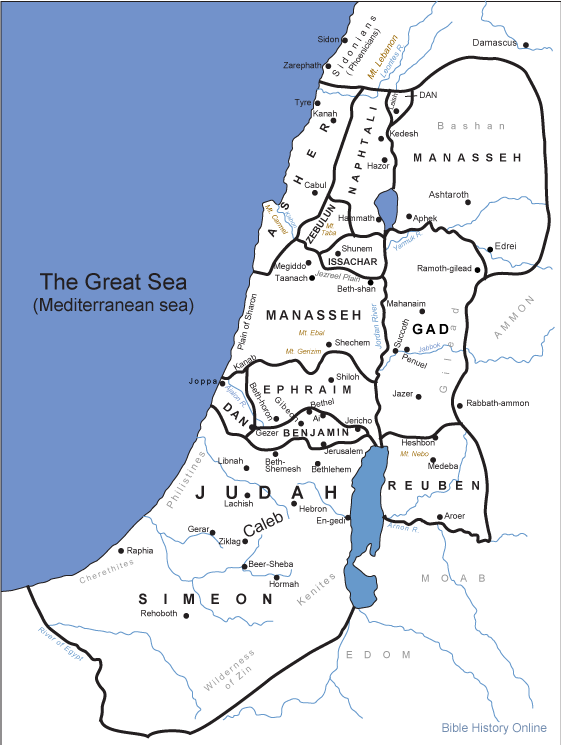
Lehi dwelt in Jerusalem all his days (1 Nephi 1:4)
He knew Egyptian as well as Hebrew (1 Nephi 1:2)
He owned property outside of Jerusalem (1 Nephi 3:16,25)
Probably an occupation - that used languages/travel tents (Nephi knew metals - and could make a sword) etc.
He is a visionary man (1 Nephi 8, 1 Nephi 5:2,4)
He was a record keeper - He wrote down his visions (1 Nephi 1:16-17)
He was a user of divine devices of revelation - the Liahona - 1 Nephi 16:9-10,16)
He was faithful - in spite of persecution (1 Nephi 2:1)
His faith wavered under - hunger and hardship (1 Nephi 16:20)
He repented and led his family well (1 Nephi 16:25-27)
His last words to his sons (1 Nephi 2:28-30)
Father Lehi - Byu Speaches
How did it go when he was ministering among the people of Jerusalem?
1 Nephi 1:18-20
Heard current prophets testifying of the destruction of Jerusalem
Prayed with all his heart on behalf of his people
Saw a pillar of Fire - standing before him on a rock
He saw and heard much, caused him to quake and trembled exceedingly..
Returned to household - and cast himself on his bed
He was carried away in a vision (note the word choice here)
Saw the heavens opened, and saw God on his throne
Saw Jesus Christ and his apostles - and their ministry
Read in a book about the destruction of Jerusalem
Exclaimed how awesome God was and his works and deeds
Not a full account - Nephi refrains - space in his book is small (evidently as stated above Lehi is a bit wordy at times...)
Why would they mock him about the destruction of Jerusalem? (all the people had already been taken... why would they come and destroy it... etc.)
Who was Nephi?
The son of Lehi - given a name that is interestingly Egyptian - as he said in his book the language of his Father.
1 Nephi 1:1 - Nephi's Name: Goodly - in Egyptian
John Gee has proposed that Nephi is the Egyptian name Nfr (Nefer), in its Semitic form Npy. "beautiful, good, perfect"  (Nfr) Journal of Book of Mormon Studies 1/1 (1992): 189–91. Gee
"I Goodly being born of Goodly Parents... " Hebraic wordplay in the very first sentence.. the build up of his parents as well as explaining why he is who he is.
He is large in stature and desires to know of God 1 Nephi 2:16
He as his father is a visionary man 1 Nephi 11-14, 1 Nephi 18:1-3
He is a very forgiving individual 1 Nephi 7:19-21 1 Nephi 16:37-39, 1 Nephi 17:47-55, 1 Nephi 18:15-23, 2 Nephi 5:1-4
He is steadfast in his faith even under extreme difficulties 1 Nephi 16:18-23,
The reason and purpose for writing this book is to persuade all men to come unto the God of Abraham and be saved 1 Nephi 6:4
The Beginning of the Journey
The Retrieval of the Brass Plates
Ishmael and his family go with them